Return to Sender: The Penfriend Version of Chemistry
Why shared interests are not the same as connection
18 July 2026
• 1903 words • 11 min read
When I first downloaded Slowly, I thought it was ridiculous.
The app had taken one of technology’s greatest achievements, instantaneous communication, and deliberately broken it.
Messages did not arrive when they were sent. They travelled according to the distance between writer and recipient, inching across a digital map as though tucked inside a canvas mailbag rather than rattling invisibly through a server.
Why, I wondered, would anybody want to go backwards?
It was also surprisingly difficult to find people who seemed remotely likely to interest me. Slowly offered the usual catalogue of human compatibility: films, music, pets, food, travel. The things almost everybody likes, listed as though admitting to an affection for dinner might reveal something private and astonishing.
I came very close to deleting it.
Instead, I wrote a profile that was unmistakably mine, left it sitting quietly in the background, and stopped trying.
A few weeks later, letters began arriving.
Australia. The Philippines. Egypt. India. Pakistan. Lithuania.
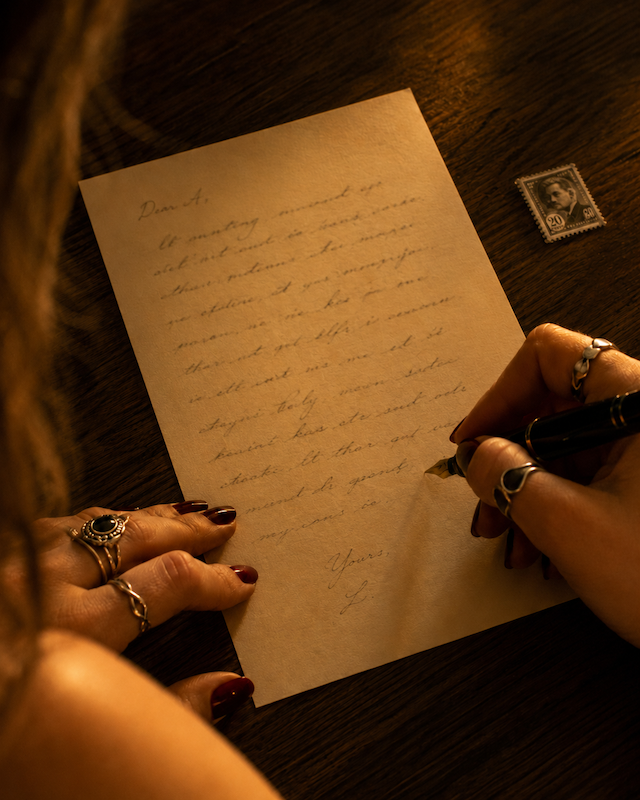
A small envelope would appear on the screen carrying the faint promise that, somewhere in the world, a stranger had sat down and chosen words for me.
Each one carries a digital stamp, chosen by the sender, another small piece of obsolete ceremony the app has lovingly restored.
That was fascinating.
It also reminded me of something the modern internet has quietly misplaced.
In 1998, from a small room in England, I entered a Yahoo chat room and began talking to a stranger. We met in person four years later and remain friends today.
Back then, the internet contained rooms.
You entered them. Other people were already there. Nobody had been pre-sorted into your field of vision because a platform had decided your preferences aligned. You simply began talking and, every now and then, encountered a mind that made the room feel larger.
Those rooms seem to have vanished.
Now we have feeds, profiles, swipes and platforms designed to show us more of whatever we already liked yesterday. The internet became faster, more personalised and somehow less likely to surprise us.
Slowly restores a little of the old strangeness.
It lets geography matter again.
If somebody in Prince Edward Island writes to me in rural Australia, the letter takes about two days to arrive. The app sends a subtle notification that something is travelling towards me. I can open a map, see who has written and watch the delivery time shrink from days to hours.
With some letters, this is merely information.
With Charlotte’s, it becomes anticipation.
She had read my profile and decided we might have something to say to one another.
Her opening message didn't begin with an introduction at all.
Instead, she asked me which impossible place I would visit if maps no longer applied.
There was someone in there.
Not merely a person with interests, but a mind already playing.
By her second letter, I was hooked. Since then, the correspondence has become progressively more alive, more ridiculous and more pleasurable to write. When one of her letters is approaching, I find myself checking the map. I calculate the likely arrival time. If it is close, I make sure I am available to open it immediately.
It is a tiny, adult version of waiting for Christmas.
This is not true of every letter.
A man I will call Mark wrote to me from the Philippines. He was retired, originally from the United States, and looking for a pen pal with whom to have enjoyable and meaningful conversations.
He had noticed that I liked films, music and pets.
He liked films too.
What genres did I enjoy?
He liked music.
What sort did I listen to?
He had four dogs and two cats.
Did I have any pets?
I began reading carefully, understood the shape of the letter almost at once, and scanned the rest in the increasingly forlorn hope of finding a surprise.
There wasn’t one.
Nothing was wrong with it.
It was polite, sincere, correctly punctuated and full of reasonable openings.
Yet by the second question, my attention had left the building. By the third, it had taken the car.
I felt a small internal groan because I understood that answering his questions would not simply produce one reply.
It would produce another letter.
I could already imagine watching it travel towards me, not with excitement, but with a faint sense of administrative dread.
The films would lead to music. The music would lead to pets. The pets would perhaps lead to food, weather and the weekly migration of everyday facts from one hemisphere to another.
Polite letters tend to continue as they begin.
Once upon a time, I would have answered anyway.
Had Mark written to me when I was at school, I might have replied in my best handwriting, listed my favourite films, described my animals and felt pleased to have a penfriend abroad.
These days, I forwarded his letter to artificial intelligence.
I did not even ask for anything.
I merely presented it.
The machine knew.
It understood that I did not want to begin a correspondence. I wanted the modern equivalent of a courteous rejection letter after an unsuccessful job interview.
Thank you for your interest.
You seem perfectly nice.
Unfortunately, on this occasion…
It produced a tactful little shit sandwich with no conversational handholds.
No question at the end.
No personal anecdote.
No mention of my cats.
Nothing Mark could pick up, admire and send back to me.
I pictured myself as Don Draper sliding an unpleasant administrative task across the desk to Peggy Olson.
I felt faintly appalled by myself.
Mark did not reply.
Praise be.
We accept without much argument that romance requires chemistry.
A person may be attractive, kind, employed, emotionally literate and capable of loading a dishwasher correctly, yet fail to produce the smallest internal flicker. Nobody sensible insists that another shared hobby should fix it.
Perhaps you both like French cinema.
Perhaps you both walk dogs.
Perhaps you both regard coriander as a personal betrayal.
None of this creates desire.
Friendship, however, is often treated as though it should operate on goodwill and common interests alone.
Someone likes books. You like books.
They want meaningful conversation. You are capable of meaningful conversation.
They have pets. You have pets.
Surely the rest is merely effort.
But friendship is not a charitable programme.
A list of shared interests can tell you that two people have subjects available. It cannot tell you whether either mind will surprise the other.
You can discover that you both love romantic comedies.
“My favourite is When Harry Met Sally.”
“Great film. Mine is Love Actually.”
And there you are.
Two people standing beside a perfectly serviceable topic with nowhere particularly interesting to go.
Instead of that certain je ne sais quoi, there is a certain Quelle heure est-il?
You are both speaking French.
Somebody has merely asked the time.
My Slowly profile is not coy about what I want.
I describe myself as seeking “the penfriend version of chemistry”. I ask for wit, taste, curiosity and a bit of life behind the eyes. I like people who notice things and ask better second questions than first ones. I explicitly reject conversation that could have been written by a teaspoon.
This is not because films, music and animals are beneath me.
I love all three.
But almost everybody loves some version of them. They are categories, not character.
I wrote my profile as a signal flare.
I hoped the right people might recognise themselves in it and that those satisfied by the exchange of ordinary preferences might drift elsewhere without taking offence.
When someone reads that profile and responds with a questionnaire, I am left wondering whether they failed to read it, failed to understand it, or simply approach every person with the same set of tools.
Perhaps Mark read every word.
But he did not read me.
And being read is the point.
At this stage of my life, I do not need letters arriving simply for the sake of receiving letters.
I have writing to do. Screenplays to finish. Essays to think through. Animals, property, gardens and the endless low-level administration of being alive.
Attention is not infinite.
A pleasant correspondence that does not nourish me still consumes the same hours as one that does.
I need depth as a thirsty person needs water.
Politeness does not quench that thirst.
It takes time away from the people who speak my language.
A mind that interests me lights a sparkler in my own.
Suddenly I have jokes to make. Memories rise. Connections appear. I want to show that person my world. I think of experiences that might delight them, unsettle them or make them laugh. I sometimes have to restrain the amount of myself trying to get through the door at once.
That is chemistry.
With some people, you do not even feel like taking the car out of the garage.
With others, you drive around the block because the battery probably needs it. You hope you may notice a road you have never seen before.
And occasionally, somebody understands the profile, catches the tone and writes in a way that sends you straight onto the coast road with the top down and the wind in your hair.
Mark identified shared subjects.
Charlotte created movement.
He asked me to list what I liked.
She asked me to imagine what I would do if power had no moral purpose and existed purely for my amusement.
One invited information.
The other invited a self.
There is still something uncomfortable about declining a sincere attempt at connection.
The polite thing is to say no when the answer is clearly no. Silence may be easier for the recipient to interpret generously, but it is rarely kinder.
It is like romance.
It is like employment.
Nobody enjoys the rejection letter, but most of us would rather receive one than wait indefinitely beside an empty inbox constructing increasingly creative explanations.
Still, a reply is not always just a reply.
It creates a return address.
Perhaps that is why we feel guilty refusing friendship before anything has gone wrong. The other person has not offended us. They have simply failed to animate us, and animation seems an uncomfortably subjective basis on which to reject a perfectly decent human being.
But beginning an exchange out of obligation does not become kinder merely because the obligation is platonic.
It simply postpones the no.
Slowly can imitate the journey of a letter.
It cannot manufacture the reason you hope for another one.
Charlotte and I could exchange email addresses tomorrow.
We have not.
If we did, something would change immediately.
There would be no small envelope moving across the map. No checking the remaining hours. No walking around smiling to myself while the answer quietly forms. The correspondence might become quicker, but perhaps also blurrier. More reactive. More blurted.
Instant gratification has never particularly interested me.
Anticipation is highly underrated.
Chemistry is not always urgency.
Sometimes it is finding someone worth waiting for.