Misconduct: What The Word Leaves Out
On power, vulnerability, and what women are expected to absorb.
2 May 2026
• 3442 words • 21 min read
Content note: This essay contains descriptions of workplace sexual harassment.

Image via Claudia Soraya on Unsplash.
A woman in a glass office
The office was made of glass.
It felt like a goldfish bowl — a little transparent room set inside a busy warehouse, with men moving forklifts, carrying orders, getting on with the ordinary business of the day. Everyone could see me. No one could see what was happening.
From the outside, I must have looked fine. A woman at a desk in a regional logistics outpost, doing a small, menial job that barely troubled the edges of her capability. Filing. Sorting papers. Entering numbers. Smiling when spoken to. Carrying on. Inside, I was going through hell.
I was forty-seven years old and in the middle of an acrimonious separation. There had been an assault, an apprehended violence order, solicitors’ letters, custody arrangements, and the kind of uncertainty that makes your whole nervous system feel temporarily borrowed. I had an eight-year-old son. I needed work that fit around him. I needed money, urgently — not for luxuries or reinvention, but for solicitors. At that point, paying legal fees felt like trying to scoop water out of a sinking boat. I couldn't stay on top of it.
So when I found part-time work in that glass office, I was grateful. I did not arrive wanting drama, romance, excitement, or any of the other things men sometimes imagine women bring with them simply by existing. I arrived wanting to work. I wanted to do the job well, keep my head down, and bring in money at a time when money was not optional.
My boss was the site manager, a man with one of those names so ordinary it might as well have been John Smith. At first, he seemed pleased with me. He praised my efficiency, trusted me early, and gave the impression that he thought I was a good hire. I believed him. I thought I was dealing with a decent, intelligent man with whom I could have an ordinary professional relationship.
The first crack
Then the messages started.
The first one was just ambiguous enough to let hope rush in where instinct had already spoken. When I read it, I felt a sinking in the pit of my stomach — that small internal please no which women know all too well. But I was an optimist, and he was dyslexic, and I wanted very badly for there to be an innocent explanation. So I reached for one. I piled my hope into that excuse and tried to smooth the moment over in my own mind before it had properly begun.
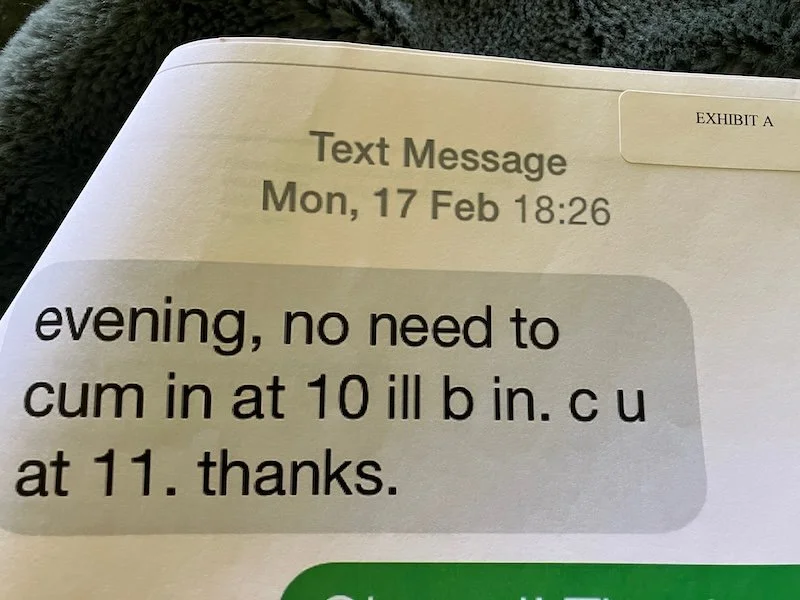
The first text that made me uneasy — just deniable enough to explain away.
That is how these things often start. Not always with a blazing obscenity, but with something just deniable enough to make a woman question her own reading. A typo. A misunderstanding. A clumsy phrase. A thing she can explain away if she is keen enough to keep the day intact.
I was very keen to keep the day intact.
That would only last a matter of days.
The explicit email arrived while I was waiting at the school bus with my son. He was dancing about beside me, full of ordinary little-boy energy, and I was glad to be there with him. My nerves were already stretched thin at that point — mostly because of what was happening with my ex-husband and the relentless pressure of solicitors, custody, and fear — so when my phone alerted me, I looked. This time there was no explaining anything away.
He had set up a separate email account, he said, so that we could be “a little more open” in our conversations. Even the separate Gmail account he used for those messages carried the username “mjhunter.” Hunter was not his surname. It was a choice, and it felt horribly apt. He called me a “very sexy woman,” told me sex “seemed to drip” from me, and asked whether I kept my stilettos on “when [I] got naughty.” Then, almost immediately afterwards, came another email with no body text at all, just a subject line: Can we play????????
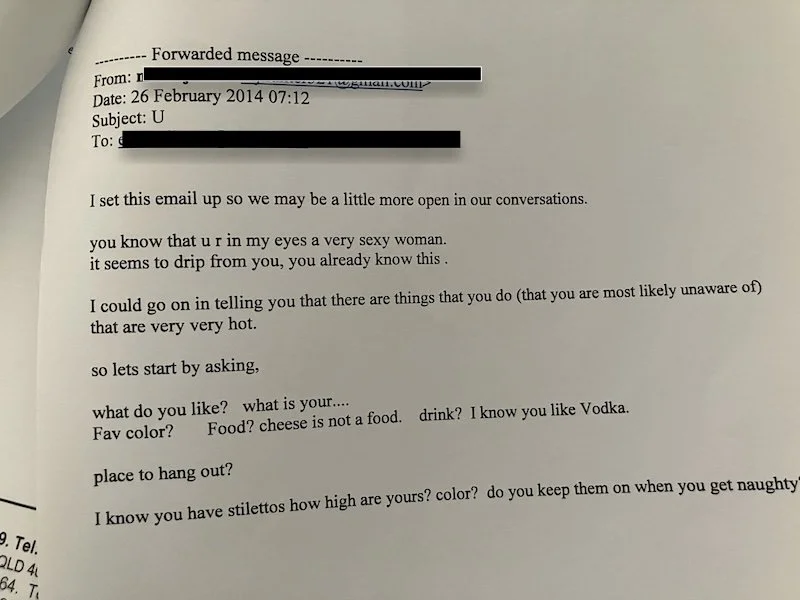
The moment ambiguity ended.
I knew immediately that I was in trouble. My overriding thought was not even outrage. It was: I can’t have this now. I need this job.
What I did not know was what to do next. How do you handle a man who is both your boss and the only other person in the office? How do you refuse him cleanly when you still have to sit opposite him, take his instructions, depend on the wage, and come back tomorrow?
So when I went into work, I went quiet.
That quietness has often been misread in women — as uncertainty, politeness, weakness, or even encouragement. It was none of those things. It was survival. I felt like a cornered animal. There were only two of us in that office. He had chosen his approach. I had nowhere to go with mine.
Later that day, after I had left work, he emailed again. This time he said it would not happen again. For a moment, I felt relieved.
Not because the email showed remorse. It didn’t. If anything, it made the insult worse. He wrote that it was “not easy to keep quiet with what is in front of me.” That was his explanation. Not that he had behaved appallingly. Not that he had crossed a line. Simply that I had presented him with something difficult for him to manage. I had gone to work to do a small administrative job for a wage I desperately needed, and he had somehow turned even that into a problem of his own arousal.
Still, I let myself hope. I thought perhaps, whatever warped logic he was using to excuse himself, he might at least leave me alone now. I thought perhaps I would be allowed to turn up, do my work, earn my pay, and go home without being sexualised in the process.
Because of course it did not stop.
The plainest version of please stop
The harassment moved into the office itself — into tone, proximity, comments, and touch. One day he came up behind me and placed his hand over mine, then remarked on the size of my hands before adding that they were “almost as big as mine.” Another time, as I was retrieving a form from his side of the office, he came up behind me and grabbed me around the waist. When I squealed, he said, “Ooh, you’re loud as well. That’s good.” I told him, “I don’t want any trouble.” He replied, “I know, neither do I.” On another day, after returning from a safety meeting where shorts had apparently been banned, he remarked that while most people would look strange in shorts with steel-capped boots, I “could get away with it.”
All of it was happening in that little glass office, that goldfish bowl of a room, with the life of the warehouse carrying on just outside. Men moved about, forklifts came and went, people did their jobs. The whole thing felt oppressively open and claustrophobic at the same time. I could be seen, but not in any way that helped me.
It all sounds so grubby and juvenile written down like this. At the time, though, it was not juvenile at all. It was exhausting. No ordinary moment at work could simply remain ordinary. Reaching for a form, asking a question, walking across the room, standing at my desk — any of it could be pulled into his sexual frame.
That is part of what the word misconduct fails to capture. It sounds administrative. Almost tidy. What it meant in practice was the contamination of the everyday. The slow removal of my right to move through a working day without being watched for something other than the work itself.
There were more emails after that. By then, the stress was no longer confined to working hours. I was losing sleep. I was getting headaches. What was happening at home had already left my nerves stretched thin; what was happening at work pushed them further. I went to a psychologist because I did not know how to carry both at once.
It was he who suggested I write to him plainly.
That turned out to be good advice. Not because it fixed anything, but because it removed ambiguity. By that stage I was exhausted enough to understand that hints, silence, and hoping he would read the room were getting me nowhere. So I wrote the kind of email a tired woman writes when she is trying to give a man one last chance to behave like a professional. I told him I saw our relationship as one between boss and employee and did not want anything else. I said I had no agenda beyond doing the best job I could at work. I asked that he contact me only about work.
It was not theatrical. It was practical. It was the plainest version of please stop.
From that point on, his demeanour changed.
Not all at once, and not in any way that would look dramatic written down in a policy document. In some ways that was what made it worse. He became moody, brittle, snappish. One day I would walk in and say good morning and be ignored. Another day a simple procedural question would be met with a barked answer, or no useful answer at all. He would disappear for stretches without explanation, leaving me to deal with people looking for him, then return in a different mood altogether. The atmosphere in that office became unpredictable, and unpredictability wears you down in its own way.
What I remember most is not one single outburst, but the cumulative effect of never knowing what version of him I was walking into.
Even so, I was not unhappy with everyone at work. Quite the opposite. I got on well with the truck drivers, the forklift drivers, the employees moving in and out of the warehouse. There was warmth and friendliness there. There were ordinary conversations, small kindnesses, the kind of human ease that makes a working day bearable.
At one point, a line-haul driver said, as I approached, “Here comes Ms Sunshine. She always has a smile.” He meant it kindly. He was right. I did smile. I was trying, with everyone else, to remain myself.
That is worth saying because harassment can distort the whole memory of a workplace if you let it. Not everything was poisoned. But the office was.
What made all of this worse was how little room I had to manoeuvre.
I was already working part-time in tertiary teaching, but that work was limited too. It was not enough to keep up with what my husband was setting in motion through the legal system. The money was not going on anything optional or aspirational. It was going on solicitors — on letters, responses, custody matters, and the endless paper trail of intimidation that follows a violent man once he can no longer control you in person.
The warehouse job, by contrast, was basic administrative work. I do not say that to sneer at it. There is nothing shameful about ordinary work. What was humiliating was how desperately I needed it. I was capable of far more than filing, sorting papers, and entering numbers, and still I could not afford to lose that wage. In that regional area, jobs that fit around children and other commitments were rare as rocking horse shit.
I was not trapped because the work was meaningful or specialised or impossible to replace in any other life. I was trapped because I needed money. He knew I had a child, a mortgage, and an abusive ex-husband using the law as another way to make my life hell. He knew I had very little room to move.
That is one of the things I understand most clearly now. Men like this do not always rely on force. Sometimes they rely on circumstance. Sometimes they step neatly into a woman’s moment of maximum vulnerability and trust that necessity will do the rest.
He also began talking to me more and more about the state of his marriage, though I had given him no encouragement and wanted no part in it. He complained bitterly about his wife, about sleeping in his car or on the sofa, about hotel stays, about how badly things were going at home. On one occasion, after a weekend away with her, he told me they had been “at it like rabbits” the whole time and that things were much better. I did not want to know about his sex life or anything about his marriage beyond what might affect the practical running of the office. But he kept placing these details in front of me as though I were somehow part of the emotional field in which they belonged.
There were other moments too — little comments that felt designed to provoke some reaction from me. He would disappear for stretches without explanation, then come back and say things like, “I can’t find my wallet. I hope I didn’t leave it at her place. That’s the last thing I need.” I said nothing. I had long since learned that anything I gave him could be used as fuel.
That was part of the exhaustion. The sexual harassment did not remain confined to the obviously offensive messages or the moments of touch. It spread into the whole atmosphere. I was being made to carry his moods, his insinuations, his marriage, his absences, his boredom, his appetite. It was never enough simply to turn up and do my job.
Not long before I was dismissed, he told me he had authority to make my role full-time. He knew I could not accept that. By then I was already juggling my son, part-time lecturing, and a life that felt held together with string. Still, I tried to find a way to keep the job. I asked whether the role could be job-share — two or three full days for me, with someone else covering the rest. I even suggested a capable woman I knew who had secretarial experience.
He rejected the idea immediately.
When I asked why, he said he “needed accountability.” It was such an absurdly inflated word for the kind of work I was doing there that it almost made me laugh. This was basic administrative work: numeric data entry, filing, sorting papers, keeping things moving. There was nothing about it that required some grand theory of accountability. What he meant, I think, was that he wanted the arrangement on his terms or not at all.
A week or so before I was terminated, head office sent round an email reminding staff of the company’s code of conduct, harassment and discrimination policy, and grievance procedure. He received it just before I did. When he noticed me reading it on my screen, he made a point of commenting that it was “just a standard email.” He had never before shown the slightest interest in what I was reading at my desk. I took that for what it was. He was nervous.
A short time later, he told me he had already interviewed two people for my position.
My employment was terminated just as my probation was due to pass.
The official reason was structural change. I did not believe it then, and I do not believe it now. Nothing in the work itself had materially changed. What had changed was that I had refused him.
I was given a letter of termination on a Monday. My final day, I was told, would be that Friday.
After he handed it to me, he seemed almost bright. Breezy, even. It was one of the better moods I had seen him in for some time, which did not improve matters.
By then, the strain of the previous weeks had begun to show more plainly in my body. I had been getting bad headaches for some time, at work and afterwards. The morning after receiving the letter, I went to the doctor. I told her about the headaches and the circumstances I was in. She signed me off work for the remainder of the week. I scanned the certificate and emailed it through before I was due to start.
That was the practical end of my employment there. It had begun with optimism, with relief at being back in the workforce, and with a genuine desire to work hard and do well. It ended with stress, headaches, and the knowledge that I had been cornered in more ways than one.
Not a misunderstanding. A pattern.
What I did not know yet was how many people around me had seen at least part of the pattern.
When I showed some of his emails to another member of staff, he was revolted but not surprised. He told me that the woman before me had also had shocking things said to her. Another employee said much the same — that she had not been looked after at all, and that she had left in a bad state. Later, I got her details and rang her at home. What she told me was awful too. I asked if she wanted to join me in taking the matter further. She thought about it, but in the end she said no. She wanted to let it go and move on. I understood that. Digging these things back up asks a lot of a woman who has already paid too much.
That conversation mattered to me. Not because I needed company in my outrage, but because it confirmed something I had already begun to suspect: this was not a misunderstanding. It was a pattern.
Taking it further
I did not leave that job meekly.
Money was still painfully tight, and I could not afford some grand legal crusade for the sake of principle alone. What I had instead was fury. A very clean, clarifying kind of fury. You take me down, I thought, and I will take you with me. All I had wanted was to do my job.
I began looking for people who dealt with discrimination matters, especially on a no-win, no-fee basis. By chance, I came across A Whole New Approach Pty Ltd, a workplace representation and advocacy company that handled matters such as discrimination, sexual harassment and unlawful dismissal. They were not a law firm, but they knew exactly how these matters worked, and from the first conversation they moved like people who had seen it all before.
The man handling my matter asked me to meet him an hour before the hearing. We sat down together and went through everything. He asked me, very plainly, whether there was anything I had left out. Had I ever gone out with my boss? Had I encouraged him in any way? Had there been coffee, phone calls, some blurred line I had forgotten to mention? I could answer him with my hand on my heart: absolutely not. There had been no invitation from me whatsoever.
That mattered. So did the speed with which things then moved. I wrote my statement — years in the police force had taught me how to do that properly — and AWNA lodged it with the Human Rights Commission on my behalf. My statement was dated 20 August 2014. The hearing was set for 1 October. I was told there was usually a long wait, but that this matter was seen as serious enough to be heard sooner rather than later. It was a complaint under the Sex Discrimination Act 1984, brought not only against the man himself but against the company through vicarious liability.
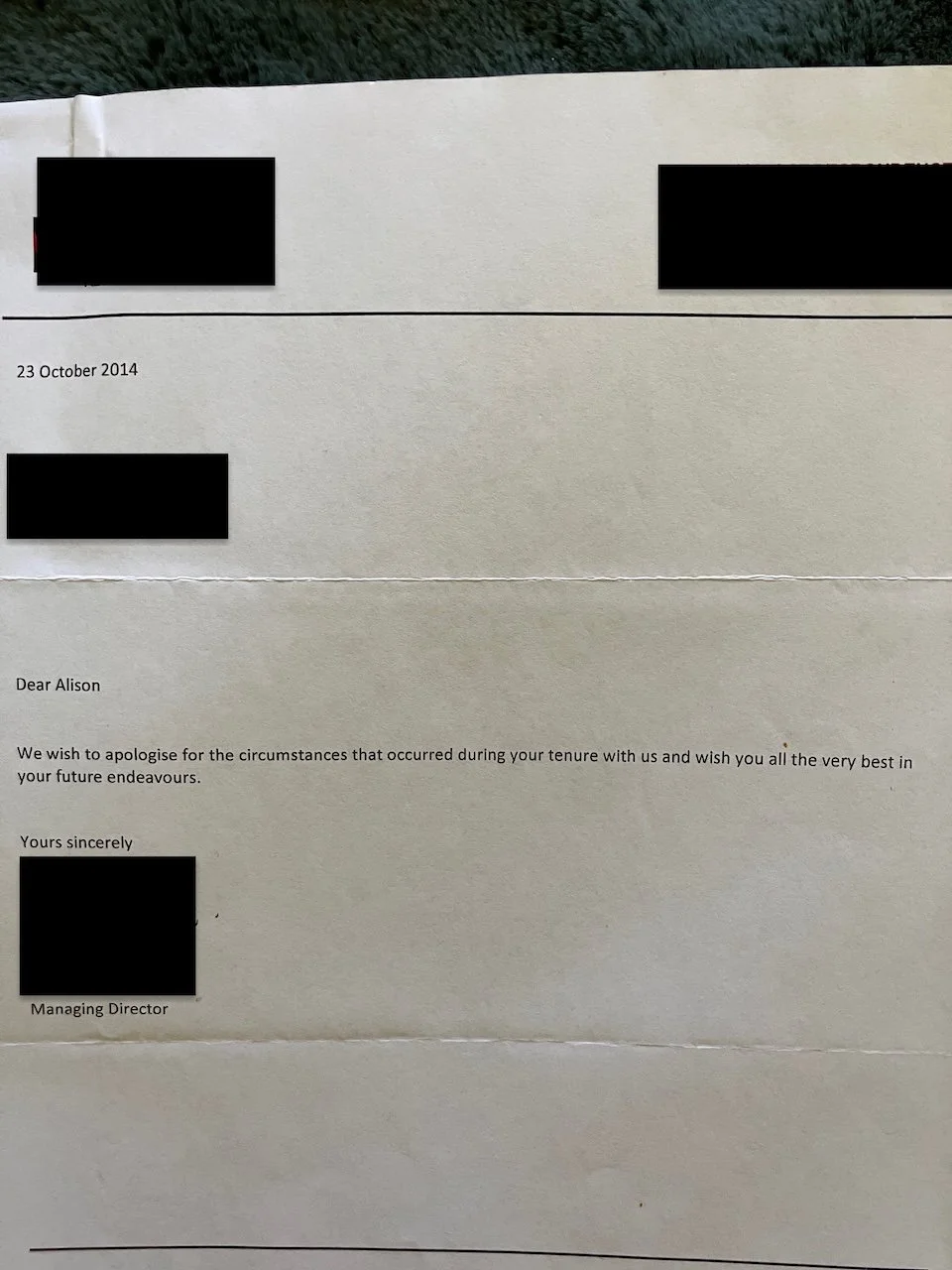
In the end, the matter settled quickly. I think they knew they did not have much ground to stand on. I was to receive a sum of money, and both the company and my boss were required to apologise for what I had endured. They kept him on, which told its own story. They had kept him on after the woman before me, too. Apparently whatever value he had to them outweighed the damage he did to women.
One thing I remember clearly from that day in Sydney is what one of the Human Rights Commission representatives said to me afterwards. She thanked me for bringing the matter to them. She said that women do not always have the courage, or the capacity, to take these things forward, and that it makes a difference when someone does. It helps the system. I have never forgotten that.
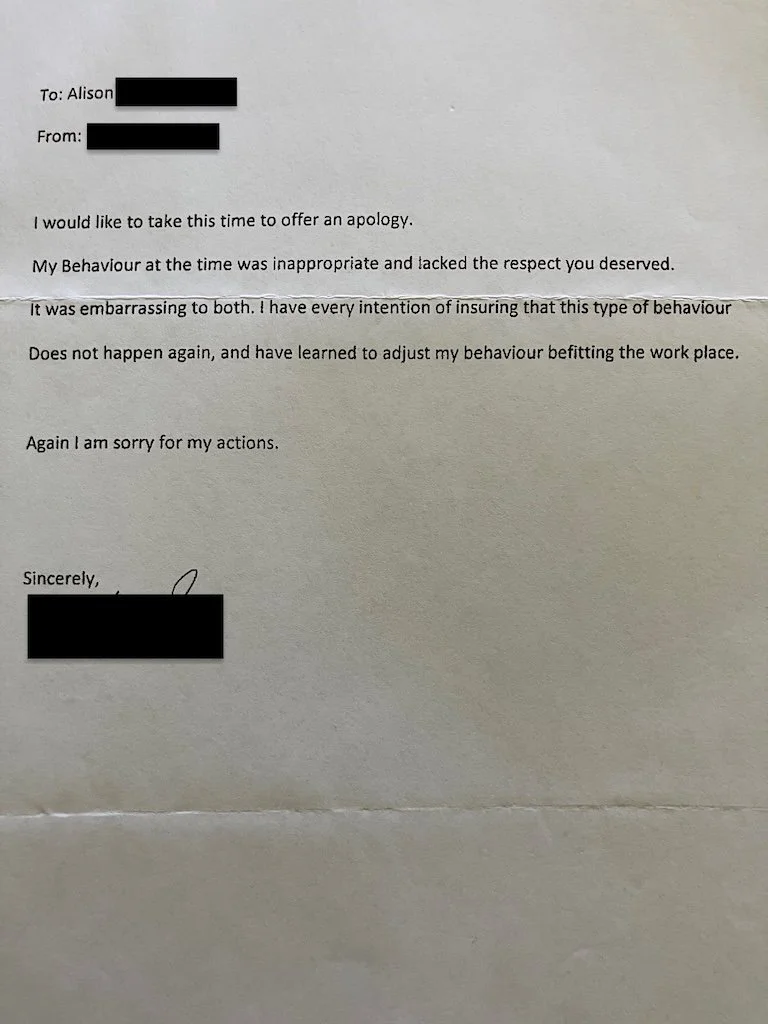
Eventually, written apologies came. One from him. One from the company.
After I left the building, having won the matter and with some compensation coming my way, I went into a shoe shop and bought myself a pair of black leather boots. A small reward. I still have those boots.