Kindness: Be the Change, They Said. No One Mentioned the Review System
Hospitality, hidden labour, and the sting of a four-star review
12 March 2026
• 2151 words • 13 min read
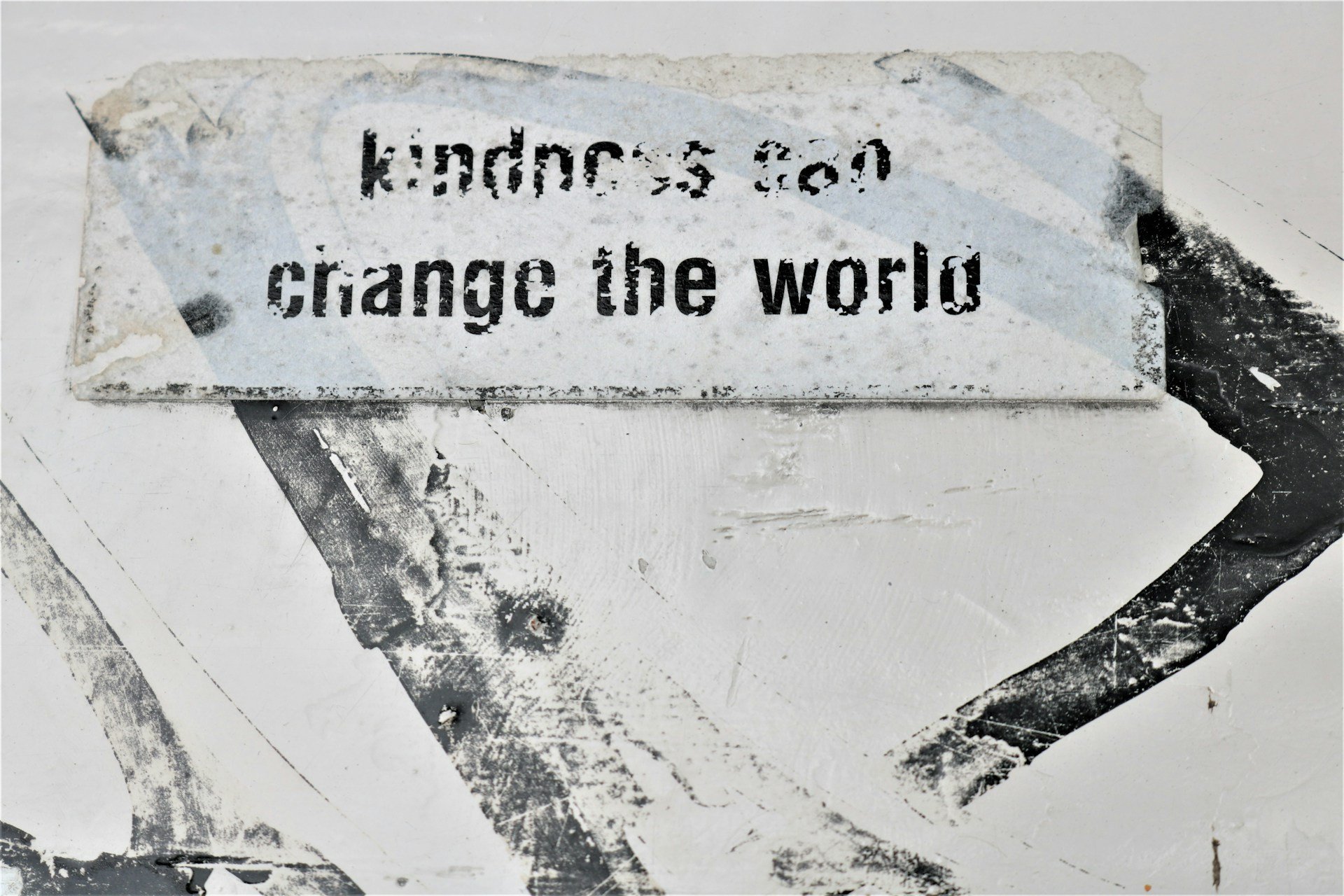
Photo by Stefano Valtorta on Unsplash
When kindness becomes part of the service
This last long-weekend, I found myself standing in my kitchen on one functioning leg, post-operation, while a man I barely knew boiled pasta on my stove.
This was not, to be clear, a social call.
He and his wife had booked my B&B at the last minute. I had already had guests on Friday and Saturday night, and because I’m currently hobbling around like an underfunded pirate, my sister had stepped in to help me survive the weekend with both dignity and crockery intact. She was the one making people feel welcome while I was still in pyjamas, still swollen, still trying to work out whether recovery is mostly pain, boredom, or the humiliation of needing help to carry a mug of tea.
By the time I met the husband properly, it was their second night. They had already experienced the room, the facilities, the patio, the general set-up, and had presumably grasped that this was not a self-catering Tuscan villa with a hidden industrial kitchen. Yet, within moments of introducing himself, he asked if I had a barbecue he could use to cook their dinner.
He had also seen me trying to water the patio plants, so it wasn’t exactly a secret that I was struggling.
Now, on paper, this is not an unreasonable question. In practice, we were in the middle of fire season in Victoria, and I live in a place where “just a small wood barbecue” is not a charming rustic detail but the beginning of a local-news cautionary tale. So I said no, unfortunately, that wasn’t possible.
He then explained that dinner had come down to two options: steaks or pasta. Like most guests, they could have eaten out or brought something back. Instead, the evening took a more intimate turn: my kitchen.
When I say “explained,” I mean in that tone some people use when they are presenting you with a problem they’ve already decided you will help solve.
Did I, he asked, have a portable stove?
I did not.
What I did have, apparently, was a tragic and incurable commitment to kindness.
So I heard myself saying that he was welcome to use my kitchen.
My actual kitchen. My personal space. The one attached to my actual life.
From there, the thing escalated in the way these things do when you are trying to be helpful and another person has no internal alarm about asking for more.
First the saucepan. Then the water. Then the salt. Then a colander. Then an offer of extra bowls. Then, because apparently I was now running a boutique rehabilitation ward crossed with a casual trattoria, I asked whether he and his wife would like some parmesan on top.
He said that would be very nice.
Of course it would.
So I handed over grated parmesan as well.
His wife remained a sort of supporting character in the drama — present enough to be fed, not present enough to say hello.
And my sister — who, I cannot stress this enough, was not the one running the Airbnb, merely the one kind enough to help her temporarily one-legged sister keep life moving — took time out yet again to show them around the church because they had expressed interest in it.
And after all that — after the room, the kitchen, the cheese, the church, the quiet bending-over-backwards of it all — they left.
I left them a five-star review.
They left me four.
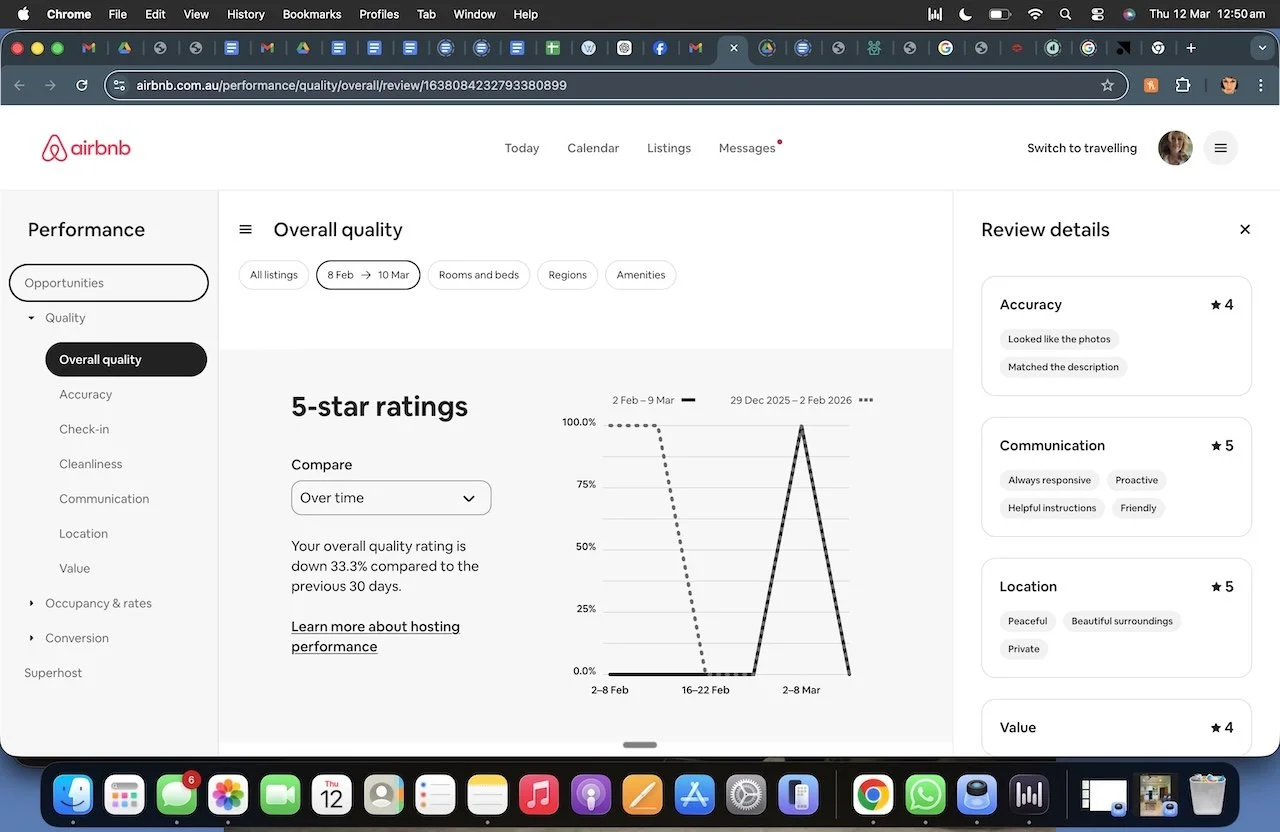
Praised in words, marked down in stars.
The quiet sting of a four-star Airbnb review
This is the point in the story where I should probably say that they trashed the room, or complained bitterly, or found a dead possum in the linen cupboard. But no. That would almost be easier. The room was left in fine condition. There was no complaint. No great grievance. No dramatic showdown. Just a public review saying nice things, paired with the quiet little administrative slap of four stars instead of five.
Comfy bed. Beautiful gardens. Amazing view of Mount Buffalo. Beautifully restored old church.
Four stars.
Marked down for accuracy and value.
Accuracy, despite also ticking that it looked like the photos and matched the description.
Value, despite the impromptu access to my kitchen, cookware, condiments, parmesan, and family goodwill.
And that, I think, is what got under my skin. Not the hard work. I don’t mind hard work. I mind being quietly undervalued.
Why being quietly undervalued hurts more than hard work
What makes this sort of thing so oddly maddening is that there is nothing to grab hold of. If someone complains, at least you have the dignity of an argument. If they tell you what was wrong, you can decide whether they’re right, wrong, mad, or simply better suited to a chain hotel with no human fingerprints on it. But this particular modern insult is softer than that. It arrives smiling. It praises the view, compliments the bed, admires the church — and then quietly places a mild administrative boot on your neck.
And because it’s Airbnb, this is not just a matter of hurt feelings or bruised pride. You don’t simply read the four stars, roll your eyes, and move on with your life. No. You are informed, in the calm bureaucratic tone now favoured by all platforms, that your “overall quality” has dropped. The same stay that required your kitchen, your cheese, your sister, and your one leg is now translated into a tiny decline in performance metrics. You are not thanked for your trouble. You are gently disciplined by an app.
There is something almost poetic about the mismatch.
Did I miss something?
Was there some private gripe?
Should I have said no to the kitchen?
Should I have kept the parmesan to myself and told him to enjoy his plain tortellini in reflective silence?
The answer, inconveniently, is no. I don’t think I would have acted differently had I been given the chance to replay it. That’s the irritating part. I still believe in helping people. I still believe in making people feel welcome. I still believe that if someone is staying at your place and is in a bind, and you can make life easier for them, then you probably should.
What I object to is not the effort. I object to the strange modern expectation that effort is baseline, endlessly available, and somehow not worth noticing.
Hospitality, hidden labour, and the female habit of smoothing things over
There is a particular kind of labour — and women know this intimately — that disappears the moment it is done well. Hosting is a classic example. If the room is clean, it is simply expected to be clean. If the instructions are clear, that is merely competent. If you are warm, flexible, accommodating and good-humoured, that is absorbed into the wallpaper of the experience. And if you go above and beyond? Well. Apparently that may still be worth four stars, depending on the moon and the moral development of the guest.
What Gandhi really meant by “be the change”
This is where I found myself thinking about that famous Gandhi line — or at least the version of it we all know, whether or not he ever said it quite that neatly: be the change you want to see in the world.
It’s a lovely sentiment until someone is boiling pasta in your kitchen during fire season and later marking you down for value.
What the quote asks of us, really, is not sainthood but integrity. It asks whether we behave according to our own values or according to whatever response we think we’ll get. Do I help because I want to live in a kinder world? Or do I help because some childish but persistent part of me still hopes kindness is a sort of vending machine — insert generosity, receive gratitude?
That, I think, is the embarrassing little truth at the centre of all this. Of course I want to believe I’m above needing the five stars. Of course I want to be the sort of woman who opens her kitchen, grates the parmesan, smiles through the inconvenience, and then floats away untouched by whether it was properly appreciated.
Sadly, I am not a Buddhist cloud. I am a woman with a business.
I don’t mind hard work. I mind being quietly undervalued.
That’s the bruise. Not that I was asked. Not even that I said yes. It’s that modern life has become so used to convenience, so used to invisible labour, so used to women smoothing things over with a smile and an extra bowl, that kindness can slip from gift to expectation without anyone noticing the point at which it happened.
How review culture turns kindness into metrics
Once that happens, there is no applause. There isn’t even proper ingratitude. There’s just a mildly disappointing rating and a line graph quietly informing you that your quality is down 33.3 percent this month, as though what took place was not a series of human decisions made with generosity and effort, but a disappointing quarter for a toaster with slipping sales.
I think that is what unsettles me most about review culture. Not just Airbnb, though Airbnb is certainly guilty, but the broader way modern systems ask us to pour ourselves into things and then translate the result into stars, metrics, and percentages. The room was spotless. The patio was spotless. The bed was comfy. The gardens were beautiful. The church was admired. The host was responsive, flexible, and — at least on this occasion — one-legged and still apparently available for culinary support.
And somehow, in the flattening logic of the platform, all of that can still come back as: good, but not quite.
The real danger: becoming cynical
There is something grimly funny in that. Also something slightly tragic. Because if you do this often enough — if you keep extending yourself only to be met with tepid acknowledgement and mild administrative punishment — you can feel the first little crusts of cynicism beginning to form.
That, to me, is the real danger.
Not the lost star.
Not even the algorithmic ticking-off.
The danger is becoming the sort of person who starts meeting the world with narrowed eyes and closed cupboards.
Choosing kindness anyway
And yet.
I know myself well enough to know I would probably do it again.
Not because I think this particular man deserved a private pasta service from the limping proprietor, but because I still can’t quite bear the alternative. I don’t want to become one of those people who withhold warmth in advance, just in case it isn’t reciprocated properly. I don’t want to become someone whose first instinct is suspicion, whose generosity comes with a terms-and-conditions document, whose cup only runneth over for the pre-approved.
But I do understand, a little better than I used to, why so many people grow sharp around the edges.
Kindness is easy when it is noticed. Easy when there’s gratitude in it. Easy when the effort lands somewhere visible and comes back to you in the form of appreciation, or warmth, or even just the small dignity of being correctly seen.
The real test is what happens when it doesn’t.
What happens when you do the right thing and the world responds, not with a slap, not with a thank you, but with that peculiarly modern shrug: four stars, lovely gardens, must try harder.
So yes, I would still lend the saucepan. I would still probably offer the cheese. I would still rather be the sort of person who helps than the sort who hoards.
But I reserve the right to be a little sarcastic about what the world does with that help once it’s given.
Because perhaps that is the grown-up version of kindness: not the naïve belief that goodness is always rewarded, but the decision to remain decent anyway, while fully acknowledging that some people will take your kitchen, your effort, your parmesan, and still leave you with a performance warning from Airbnb.
Be the change you want to see in the world, by all means.
Just don’t expect the algorithm to applaud.